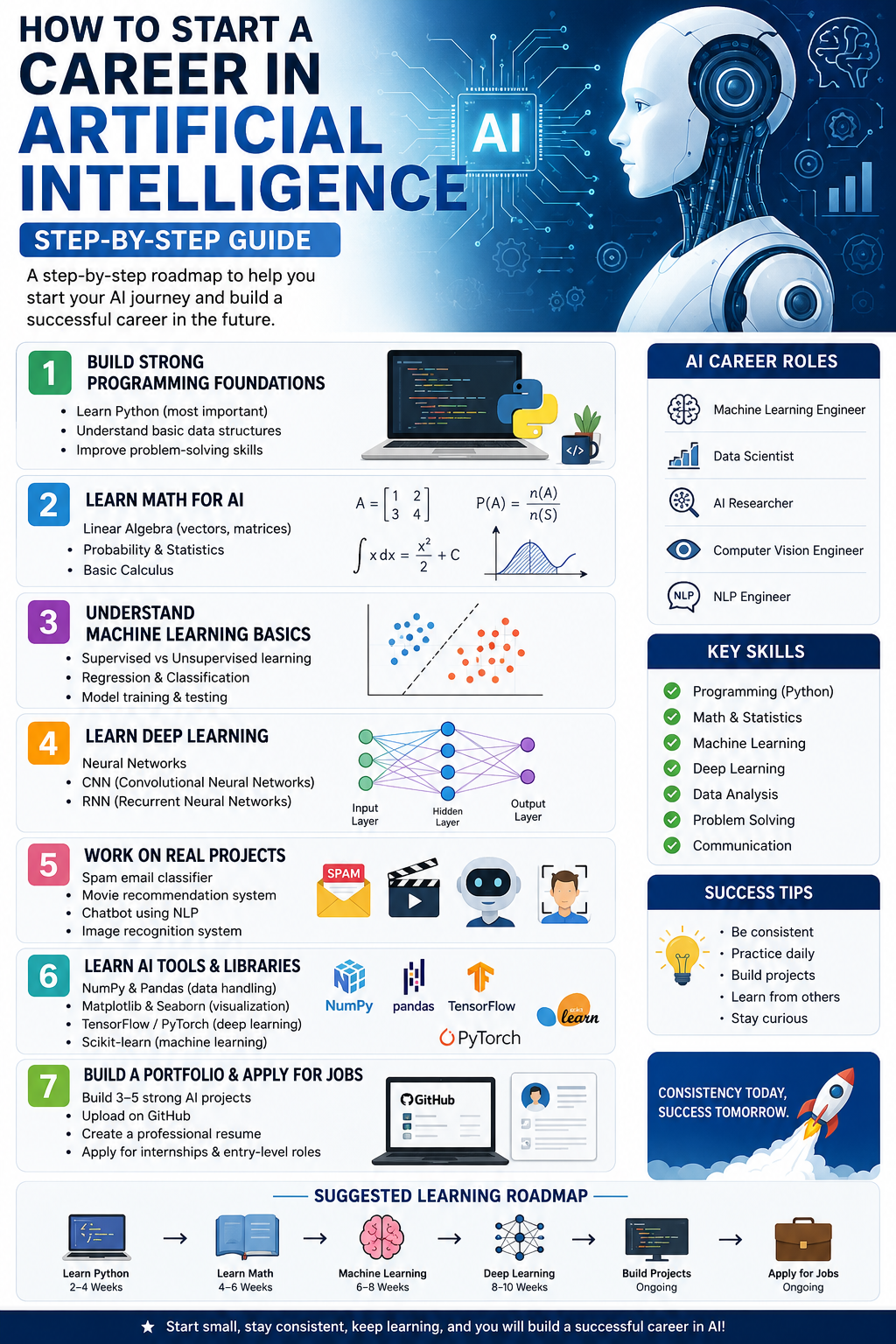
How to Start a Career in Artificial Intelligence (Step-by-Step Guide)
Artificial Intelligence (AI) is one of the fastest-growing fields in tech today, shaping industries like healthcare, finance, education, and automation. A career in Artificial Intelligence doesn’t require you to be a genius—it requires a structured learning path, consistency, and real-world practice.
Below is a clear step-by-step guide to help you start your AI career from scratch.
🧠 What an AI Career Looks Like


6
Before learning, it’s important to understand the roles in AI:
- Machine Learning Engineer
- Data Scientist
- AI Researcher
- Computer Vision Engineer
- NLP Engineer
Most roles rely heavily on math, coding, and data handling.
Step 1: Build Strong Programming Foundations
Start with programming, especially:
- Python (most important)
- Basic data structures (lists, dictionaries, loops)
- Problem-solving skills
Why Python?
Because it has powerful AI libraries like NumPy, Pandas, TensorFlow, and PyTorch.
Step 2: Learn Math for AI
You don’t need advanced math at first, but focus on:
- Linear Algebra (vectors, matrices)
- Probability & Statistics
- Basic Calculus
These concepts help you understand how models “learn”.
Step 3: Understand Machine Learning Basics
Machine Learning is the core of AI careers.
Start learning:
- Supervised vs Unsupervised learning
- Regression & classification
- Model training & testing
Step 4: Learn Deep Learning
Deep Learning is used in:
- Image recognition
- Speech recognition
- Chatbots
Focus on:
- Neural networks
- CNN (Convolutional Neural Networks)
- RNN (Recurrent Neural Networks)
Step 5: Work on Real Projects


6
Projects help you stand out:
- Spam email classifier
- Movie recommendation system
- Chatbot using NLP
- Image recognition system
Upload your projects on GitHub.
Step 6: Learn AI Tools & Libraries
Important tools:
- NumPy & Pandas (data handling)
- Matplotlib & Seaborn (visualization)
- TensorFlow / PyTorch (deep learning)
- Scikit-learn (machine learning)
Step 7: Build a Portfolio & Apply for Jobs
Your portfolio should include:
- 3–5 strong AI projects
- GitHub repositories
- Resume with skills and tools
- Kaggle profile (optional but powerful)
Then apply for:
- Internships
- Entry-level Data Scientist roles
- Junior Machine Learning Engineer roles
🚀 Final Conclusion
Starting a career in Artificial Intelligence is absolutely achievable if you follow a structured path. Begin with coding, build your math foundation, learn machine learning, and most importantly—keep building real projects.
Consistency matters more than speed. Even 1 hour daily practice can lead you into a successful AI career over time.