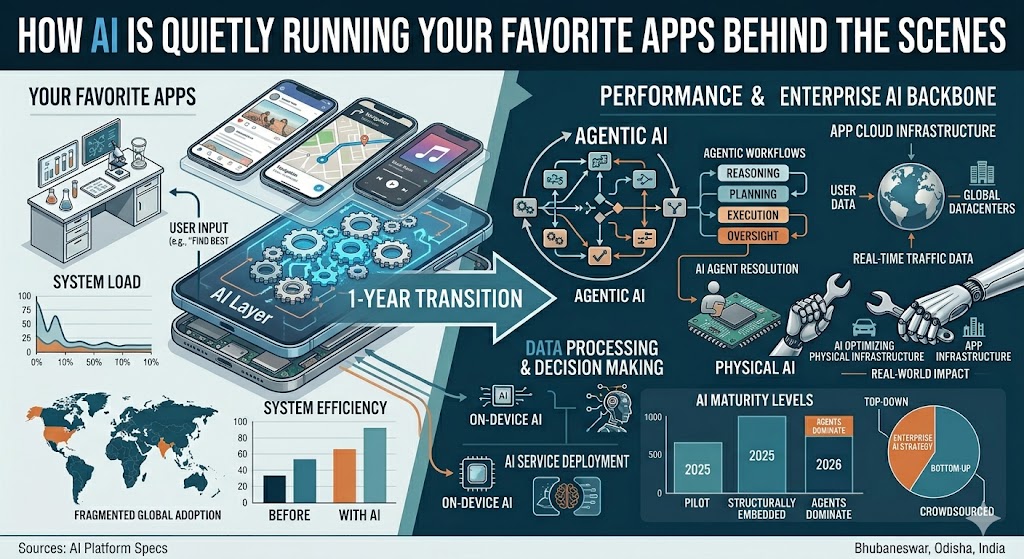
How AI Is Quietly Running Your Favorite Apps Behind the Scenes
AI is deeply embedded in modern apps, quietly shaping what you see and do without you noticing. It powers recommendation systems on platforms like Netflix and YouTube, personalizes feeds and home screens on social media and shopping apps, improves search by understanding user intent, and even predicts your next actions such as purchases, routes, or workouts. Behind the scenes, AI also strengthens security by detecting fraud and unusual activity in real time. All of this happens through complex data systems and machine learning models working continuously in the background, making apps feel smarter, more intuitive, and highly personalized for each user.
Most people think their favorite apps are powered mainly by clean design, fast internet, and a few smart features like chatbots or recommendations. In reality, there’s a hidden layer working constantly in the background—AI systems that predict, rank, filter, and personalize almost everything you see.
From Netflix suggestions to Instagram feeds and Google Maps routes, AI is not just “inside” these apps—it is actively shaping your experience in real time. Modern mobile apps are increasingly AI-native systems where intelligence is embedded into the core architecture rather than added as an extra feature.
Below is a deep look into how AI quietly runs the apps you use every day, without most users ever noticing.
1. The Invisible Brain: Recommendation Engines


8
Every time you open Netflix, Spotify, YouTube, or Amazon, you’re not seeing a “homepage.” You’re seeing an AI prediction.
Recommendation systems analyze:
- What you clicked
- How long you stayed
- What you skipped
- What similar users liked
These signals are processed through machine learning models that rank thousands of options in milliseconds.
Modern recommendation engines don’t just react—they predict. They estimate what you are likely to engage with next, often before you even realize it yourself.
That’s why your feed feels “uncannily accurate.” It’s not luck—it’s probability.
2. Personalization: Every User Sees a Different App


6
No two users actually see the same version of a modern app.
AI systems continuously build a “digital profile” of you based on:
- Behavior history
- Location and time patterns
- Device usage habits
- Interests inferred from activity
Then the app dynamically adjusts:
- Home screen layout
- Notifications
- Content priority
- Search results
This is called hyper-personalization, and it has become the default expectation in 2026 apps.
What feels like a static interface is actually a constantly changing system designed specifically for you.
3. Search That Understands Intent, Not Just Words


7
Search used to be simple: you typed words, and apps matched keywords.
Now, AI understands intent.
For example:
- “cheap hotels near beach” → travel intent + budget + geography
- “best running shoes for knee pain” → health + product type + problem
- “fun movies tonight” → mood + time context
AI models use natural language processing to interpret meaning, not just text.
That’s why search results differ from person to person—even for identical queries.
4. Predictive Actions: Apps That Guess What You’ll Do Next


6
Modern apps don’t wait for you to act—they anticipate your actions.
Examples:
- Banking apps predict spending patterns and warn you early
- Fitness apps suggest workouts based on your history
- Shopping apps remind you about items you are likely to buy
- Maps predict traffic before you start driving
This is predictive analytics in action. AI learns patterns from massive datasets and forecasts future behavior with increasing accuracy.
In simple terms: apps are no longer reactive tools. They are becoming predictive assistants.
5. Chatbots and AI Assistants Inside Apps


7
Many apps now include conversational AI that replaces traditional support or navigation.
Instead of clicking menus, you can:
- Ask questions
- Get instant answers
- Perform tasks like booking or tracking orders
These assistants use natural language processing (NLP) to understand and respond like humans.
Behind the scenes, they connect to databases, APIs, and AI models that decide the best response in real time.
What feels like a simple chat window is actually a complex orchestration of systems.
6. AI in Feeds: Why Your Timeline Never Looks the Same Twice


7
Social media apps like Instagram, TikTok, and Facebook are powered by ranking AI systems.
Instead of showing posts chronologically, AI:
- Collects thousands of candidate posts
- Scores them based on relevance
- Ranks them in order of predicted interest
The result is a “For You” feed that is uniquely personalized for each user.
This is why two people scrolling at the same time see completely different content. The feed is not a list—it is a prediction engine.
7. Fraud Detection and Security: The Silent Protector


6
AI is also protecting your apps in ways you rarely notice.
It monitors:
- Login patterns
- Device fingerprints
- Location changes
- Unusual behavior
If something looks suspicious, AI can:
- Block transactions
- Trigger verification
- Flag accounts for review
This happens in milliseconds, often without interrupting your experience unless necessary.
Modern app security has shifted from reactive defense to predictive prevention.
8. Behind the Curtain: The AI Infrastructure Layer


6
Everything described above depends on a hidden system of infrastructure:
- Data collection pipelines
- Model training systems
- Real-time inference engines
- Cloud + on-device AI processing
Modern apps often combine cloud AI with on-device AI to improve speed and privacy.
This infrastructure continuously learns from user behavior, updates models, and pushes improvements back into the app.
So the app you used today is not exactly the same one you used yesterday—it has already evolved slightly.
9. Why You Don’t Notice Any of This
The most interesting thing about AI in apps is not what it does—but how invisible it is.
Good AI systems are designed to:
- Reduce friction
- Hide complexity
- Make decisions feel “natural”
If everything works smoothly, users don’t think about AI at all. They just feel the app is “smart.”
That’s the goal: not attention, but invisibility.
Conclusion
AI is no longer a feature you see—it is the system you feel.
It powers recommendations, rankings, search, personalization, security, and even the timing of notifications. Most of what you interact with in modern apps is the result of thousands of AI predictions happening in the background every second.
As apps continue evolving, they will move from being tools you control to intelligent systems that collaborate with you.
The next time your app “just knows” what you want, it’s not magic.
It’s AI quietly doing its job behind the scenes.