AI CEOs Gain Global Political Influence: How Artificial Intelligence Is Reshaping Global Governance


Introduction
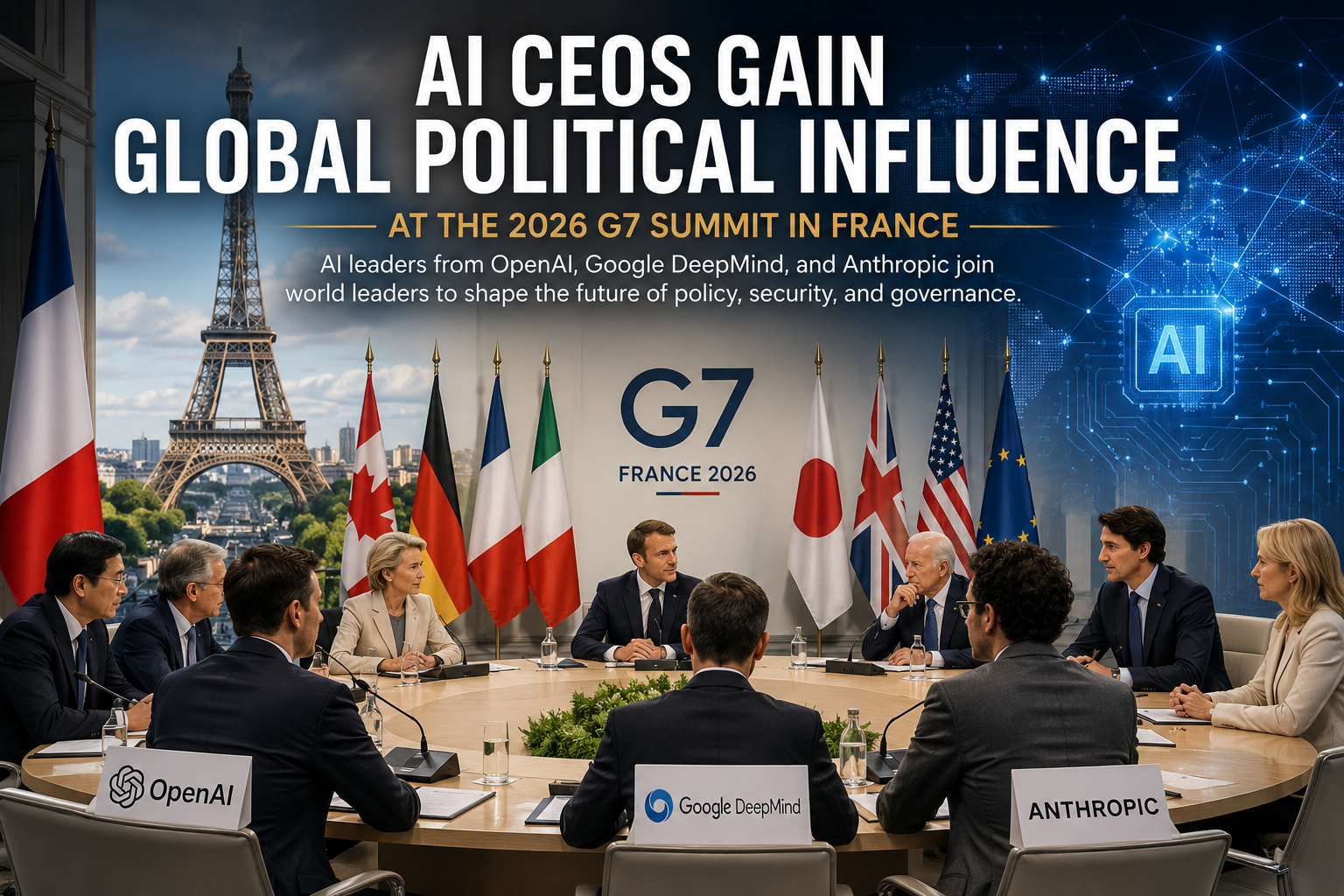
Artificial Intelligence is no longer just a technological innovation transforming businesses and consumer experiences. In 2026, AI has become a central topic in international diplomacy, national security, economic development, and global governance. One of the clearest signs of this shift emerged during the 2026 G7 Summit in France, where chief executives and leaders from major AI companies such as OpenAI, Google DeepMind, and Anthropic participated in discussions alongside presidents, prime ministers, and senior policymakers.
Their presence reflected a new reality: AI companies are no longer simply technology providers. They are becoming influential stakeholders in shaping global policy, security strategies, economic frameworks, and the future of human society.
As governments seek to understand and regulate rapidly advancing AI systems, technology executives are increasingly finding themselves at the center of international decision-making processes. This growing influence raises important questions about governance, accountability, innovation, and the balance of power in the digital age.
The Growing Importance of AI in Global Affairs
Artificial Intelligence has become one of the most transformative technologies of the 21st century. Its applications extend far beyond chatbots and productivity tools. AI now impacts healthcare, finance, defense, education, manufacturing, transportation, and scientific research.
Governments worldwide recognize that AI will play a critical role in determining future economic competitiveness. Nations investing heavily in AI research and infrastructure are positioning themselves to gain significant advantages in productivity, innovation, and military capabilities.
Several factors have accelerated AI’s rise as a geopolitical issue:
Economic Competitiveness
Countries view AI as a major driver of future economic growth. AI-powered automation, data analysis, and decision-making systems can significantly increase productivity across industries.
National Security
Military organizations are exploring AI applications for intelligence gathering, cybersecurity, logistics, and autonomous systems. As a result, AI development has become closely linked with national security concerns.
Digital Sovereignty
Governments are increasingly focused on maintaining control over critical digital infrastructure and ensuring that AI technologies align with national interests and values.
Global Cooperation
Because AI development affects multiple countries simultaneously, international cooperation has become essential for establishing standards, ethical guidelines, and safety protocols.
These factors have elevated AI from a technological issue to a strategic geopolitical priority.
Why AI CEOs Are Being Invited to Global Summits


Historically, international summits primarily involved political leaders, diplomats, and economic experts. Today, technology leaders are increasingly participating because they possess expertise that governments need.
AI companies are developing systems that are often more advanced than what policymakers fully understand. As a result, governments rely on industry experts to provide insights into:
- Emerging AI capabilities
- Potential risks and threats
- Regulatory frameworks
- Economic opportunities
- Workforce transformation
- AI safety measures
Executives from leading AI organizations can offer firsthand perspectives on how rapidly the technology is evolving and what safeguards may be necessary.
Their participation also helps governments create more informed policies that balance innovation with public safety.
The Role of OpenAI, Google DeepMind, and Anthropic
Three organizations have become particularly influential in global AI discussions.
OpenAI
OpenAI has become one of the world’s most recognized AI companies through the development of advanced language models and AI assistants. The organization has consistently emphasized the importance of AI safety, alignment, and responsible deployment.
OpenAI’s growing influence stems from its role in bringing advanced AI capabilities to businesses, governments, researchers, and consumers worldwide.
Google DeepMind
Google DeepMind has long been a leader in AI research and scientific breakthroughs. The company has contributed to advances in areas such as protein folding, reinforcement learning, and large-scale AI systems.
Its expertise makes it a valuable participant in discussions about scientific innovation, healthcare applications, and long-term AI development.
Anthropic
Anthropic has gained recognition for its focus on AI safety and constitutional AI approaches. The company frequently contributes to discussions about responsible AI deployment and risk management.
Anthropic’s perspective is particularly relevant as governments seek frameworks for ensuring that powerful AI systems remain aligned with human values.
AI Governance: A New International Priority
One of the primary topics discussed at global summits is AI governance.
AI governance refers to the policies, regulations, standards, and oversight mechanisms designed to guide the development and deployment of artificial intelligence technologies.
Governments face a difficult challenge. Overregulation could slow innovation and economic growth, while insufficient oversight could increase risks associated with misinformation, cyberattacks, discrimination, or misuse of advanced AI systems.
Key governance priorities include:
Transparency
Organizations may be required to disclose how AI systems are trained, tested, and deployed.
Accountability
Clear frameworks are needed to determine responsibility when AI systems cause harm or make incorrect decisions.
Safety Testing
Advanced AI models may undergo rigorous evaluations before public release.
International Standards
Countries are exploring shared standards to prevent fragmented regulations across regions.
The participation of AI company leaders helps policymakers understand practical approaches to implementing these goals.
AI and National Security Concerns


National security has become one of the most important areas of AI policy discussion.
Advanced AI systems can strengthen cybersecurity defenses, improve intelligence analysis, and support military planning. However, they can also be used by malicious actors to conduct sophisticated cyberattacks, generate disinformation, or automate harmful activities.
Governments are increasingly concerned about:
- AI-enabled cyber threats
- Deepfake misinformation campaigns
- Autonomous weapons systems
- Strategic competition among nations
- Protection of critical infrastructure
Because leading AI companies possess significant expertise in these areas, their input has become valuable during high-level security discussions.
The relationship between governments and AI firms is therefore becoming more collaborative, particularly regarding risk assessment and mitigation strategies.
Economic Transformation and the Future of Work
The economic impact of AI is another major topic driving the political influence of technology leaders.
AI has the potential to reshape labor markets in profound ways. While new opportunities are emerging, many existing jobs may be transformed or partially automated.
Industries already experiencing significant AI-driven changes include:
- Customer service
- Software development
- Marketing
- Finance
- Manufacturing
- Healthcare
- Logistics
Governments must prepare for workforce transitions by investing in education, reskilling programs, and digital literacy initiatives.
AI executives are often invited to policy discussions because they possess valuable insights into how businesses are adopting AI technologies and how employment patterns may evolve over the coming decade.
The Debate Over AI Regulation
Despite widespread agreement that AI requires oversight, significant debates remain regarding the best regulatory approach.
Some policymakers advocate for comprehensive regulations to ensure safety and accountability.
Others argue that excessive restrictions could reduce competitiveness and slow technological progress.
The central challenge is finding a balance between:
- Innovation and safety
- Economic growth and risk management
- National interests and international cooperation
- Corporate responsibility and government oversight
AI company leaders frequently contribute to these discussions by sharing technical expertise and practical perspectives on implementation challenges.
However, critics argue that allowing major AI firms substantial influence over policymaking could create conflicts of interest.
This tension remains an important aspect of ongoing global debates.
Opportunities Created by Public-Private Collaboration
Collaboration between governments and AI companies can produce significant benefits when managed effectively.
Potential advantages include:
Faster Innovation
Partnerships can accelerate research and development efforts.
Better Safety Standards
Industry expertise can help policymakers design realistic safety requirements.
Economic Growth
Cooperation can encourage investment and support emerging industries.
Scientific Advancement
AI technologies are helping researchers solve complex challenges in medicine, climate science, and engineering.
International Cooperation
Technology leaders can facilitate cross-border discussions on shared challenges and opportunities.
When governments and AI organizations work together responsibly, they can create frameworks that promote both innovation and public welfare.
Risks of Concentrated Influence
As AI companies gain greater political influence, concerns about accountability and democratic oversight continue to grow.
Some experts worry that a small number of technology firms could exert disproportionate influence over policies affecting billions of people.
Key concerns include:
- Concentration of technological power
- Limited public transparency
- Regulatory capture
- Unequal access to AI resources
- Global disparities in technological development
Addressing these concerns requires strong governance structures, public engagement, independent oversight, and international cooperation.
Ensuring that AI development benefits society broadly—not just governments or corporations—remains an important objective.
What the Future May Look Like
The participation of AI CEOs at international summits is likely to become increasingly common.
As AI systems become more capable and integrated into critical sectors, governments will continue seeking expert guidance from technology leaders.
Future discussions may focus on:
- Artificial General Intelligence (AGI)
- Advanced AI safety frameworks
- Global regulatory standards
- AI-driven economic policies
- Digital infrastructure investments
- International security cooperation
The relationship between governments and AI companies will play a major role in shaping how these issues are addressed.
Success will depend on maintaining a balance between innovation, accountability, economic opportunity, and public trust.
Conclusion
The 2026 G7 Summit in France highlighted a significant shift in global governance. AI leaders from OpenAI, Google DeepMind, and Anthropic participated alongside world leaders, demonstrating how artificial intelligence has become a strategic issue extending far beyond the technology sector.
As AI continues to influence economies, national security, education, healthcare, and public policy, the role of AI companies in global decision-making is likely to expand further. Their expertise can help governments navigate complex technological challenges, but it also raises important questions about transparency, accountability, and democratic oversight.
The coming years will determine how effectively nations, international organizations, and technology companies collaborate to ensure that AI serves humanity’s broader interests. The decisions made today may shape the future of global governance for decades to come.