Apple Partners with Google Gemini to Power Next-Generation Siri: A Rare Tech Alliance


7
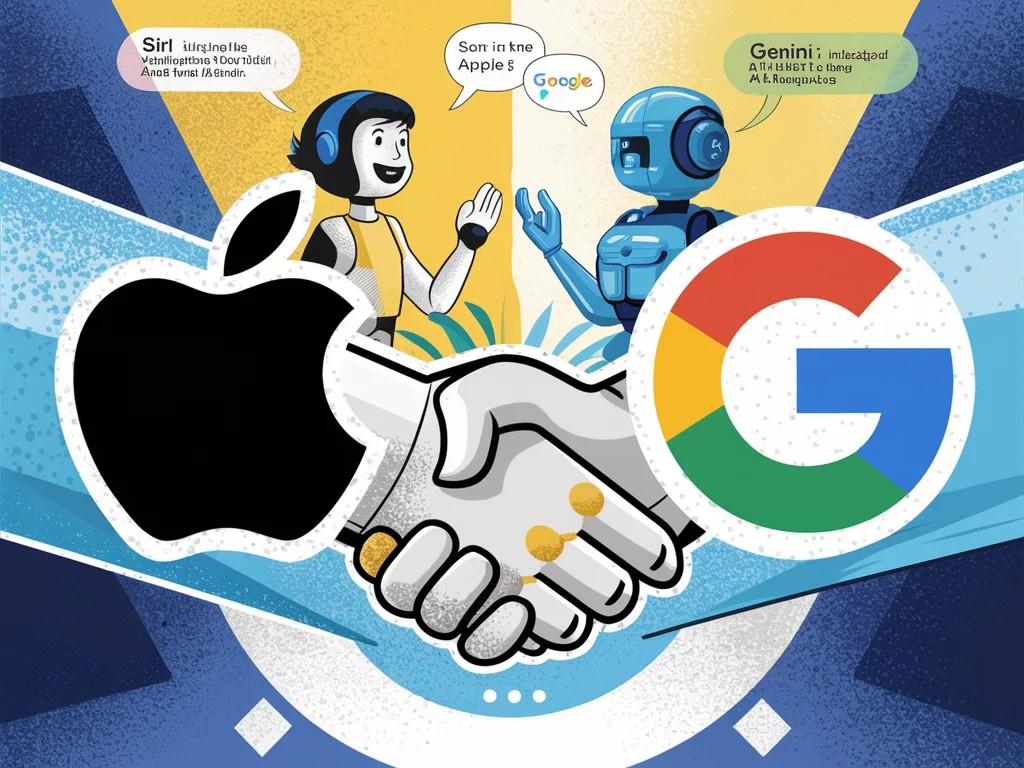
In a move that few in the tech industry expected, Apple has confirmed a strategic partnership with Google to integrate Google’s Gemini AI models into the foundation of its next-generation Siri system. This collaboration marks a rare moment where two of Silicon Valley’s biggest competitors are aligning their strengths to redefine the future of voice assistants and personal AI.
The announcement signals a major shift in Apple’s AI strategy, especially as competition in generative AI intensifies with players like OpenAI, Anthropic, and Microsoft pushing rapid innovation. By leveraging Google’s Gemini models, Apple aims to transform Siri from a basic voice assistant into a deeply contextual, multi-step reasoning AI that can handle complex personal and professional tasks.
A Historic Collaboration Between Tech Rivals


5
Apple and Google have long been competitors across multiple domains—smartphones, operating systems, browsers, and cloud services. Despite this rivalry, the partnership around Gemini AI shows a pragmatic shift: even the largest tech ecosystems sometimes need to collaborate to accelerate innovation.
At the core of this deal is Apple’s decision to integrate Gemini as a foundational model layer for Siri. Instead of relying solely on in-house models, Apple will reportedly use Gemini for:
- Advanced natural language understanding
- Multi-step reasoning tasks
- Context-aware personal assistance
- Cross-app workflow execution
Apple will still maintain strict control over privacy, system design, and user experience, but Google’s Gemini provides the raw intelligence layer that powers reasoning and generation.
This hybrid approach allows Apple to focus on hardware optimization, privacy architecture, and seamless OS integration, while Google supplies state-of-the-art AI model capabilities.
Why Apple Needed Gemini for Siri’s Evolution


4
Siri, introduced in 2011, was once a groundbreaking voice assistant. However, in recent years, it has lagged behind competitors in conversational intelligence and contextual awareness. While Siri remains tightly integrated into the Apple ecosystem, it has struggled with:
- Complex multi-step queries
- Open-ended reasoning tasks
- Long-context conversations
- Cross-app task automation
Meanwhile, generative AI systems like Gemini have demonstrated the ability to:
- Write and summarize long documents
- Plan tasks across multiple steps
- Understand multimodal inputs (text, image, audio)
- Maintain long conversational memory
Apple’s decision to integrate Gemini is therefore not just strategic—it is evolutionary. Instead of rebuilding everything from scratch, Apple is accelerating Siri’s transformation by standing on top of one of the most advanced AI foundations available.
Inside Gemini: The AI Engine Behind the Upgrade


6
Google’s Gemini models are designed as multimodal AI systems capable of understanding and generating across different types of data—text, images, code, and more. Unlike earlier generation models, Gemini is optimized for reasoning and planning rather than just text prediction.
Key capabilities expected to be leveraged in Siri include:
1. Multimodal Understanding
Siri will be able to interpret combined inputs such as:
- “Summarize this email and create a reminder based on it”
- “Look at this image and suggest actions”
2. Advanced Task Planning
Instead of executing single commands, Siri will handle workflows like:
- Booking travel, comparing options, and adding calendar events
- Managing multi-app tasks across Apple services
3. Context Retention
Gemini allows longer memory windows, enabling Siri to:
- Maintain context over extended conversations
- Understand user preferences and habits
4. Natural Conversation Flow
The upgraded Siri is expected to feel less like a command tool and more like a conversational assistant.
What Apple Brings to the Table


4
While Google provides the AI model, Apple is far from a passive partner. Apple’s strengths in this collaboration are equally critical:
1. Privacy-First Architecture
Apple is expected to run parts of the AI processing directly on-device using Apple Silicon, reducing reliance on cloud servers and improving privacy.
2. Ecosystem Integration
Siri is deeply embedded across:
- iPhone
- iPad
- Mac
- Apple Watch
- HomePod
- CarPlay
This ecosystem gives Apple a unique advantage in deploying AI as a seamless daily assistant.
3. Hardware Optimization
Apple’s Neural Engine and custom chips allow efficient AI inference, potentially reducing latency when interacting with Gemini-powered Siri.
4. User Experience Control
Apple retains full control over Siri’s interface, behavior, and system integration, ensuring the assistant feels native rather than third-party.
How the New Siri Could Work in Real Life


6
The real transformation will be visible in everyday usage. Here are examples of how Gemini-powered Siri might behave:
Morning Routine Automation
Instead of multiple commands, a user could say:
“Plan my day based on my schedule and emails.”
Siri could:
- Summarize emails
- Suggest priority tasks
- Adjust calendar events
- Recommend travel time
Travel Planning
“Plan a weekend trip to Goa under ₹30,000.”
Siri could:
- Compare flights and hotels
- Suggest itineraries
- Book reservations
- Add reminders
Work Assistance
“Turn this document into a presentation and email it to my team.”
Siri could:
- Extract key points
- Generate slides
- Draft email content
- Attach and send files
Smart Home Control
Siri could dynamically manage:
- Lighting preferences
- Energy optimization
- Security systems
- Routines based on behavior
This is no longer just voice control—it becomes proactive digital assistance.
Industry Impact: A New AI Power Structure


4
This partnership reshapes the competitive landscape of AI in several ways.
1. Blurring of Rival Boundaries
Apple and Google competing in hardware and software while collaborating on AI signals a more interconnected tech ecosystem.
2. Pressure on Other AI Players
Companies like Microsoft and OpenAI may face increased pressure as AI becomes deeply embedded into mobile operating systems at scale.
3. Shift Toward Hybrid AI Models
Instead of single-company AI stacks, the future may involve:
- Model providers (Google, OpenAI, Anthropic)
- Device integrators (Apple, Samsung)
- Cloud infrastructure partners
4. AI as a Utility Layer
AI is becoming less of a product and more of a utility layer embedded across ecosystems.
Challenges and Concerns
Even with the promise of a smarter Siri, this partnership raises important questions:
Privacy and Data Control
Apple’s strict privacy stance will be tested as external AI models are introduced into core user experiences.
Dependency on External Models
Relying on Google Gemini could create long-term dependency risks.
Performance Consistency
Ensuring consistent response times across devices and networks will be critical.
User Trust
Users must trust that Siri remains Apple-controlled, even if powered by external intelligence.
The Future of Siri: From Assistant to Intelligent Companion
The integration of Google Gemini into Siri marks a turning point in personal computing. Siri is no longer just a voice interface—it is evolving into an intelligent system capable of understanding, reasoning, and acting across the digital ecosystem.
If successful, this collaboration could redefine what users expect from AI assistants:
- Not just answering questions
- But anticipating needs
- Not just executing commands
- But managing workflows
- Not just reacting
- But assisting proactively
Conclusion
The Apple–Google Gemini partnership represents one of the most surprising and strategically significant collaborations in recent tech history. While both companies remain competitors in many areas, the shared goal of advancing AI capabilities has led to a pragmatic alliance.
For Apple, it accelerates Siri’s transformation into a true next-generation AI assistant. For Google, it expands Gemini’s reach into one of the world’s largest consumer ecosystems. And for users, it could finally deliver the long-promised vision of a truly intelligent, context-aware digital assistant.
The future of Siri is no longer just about voice commands—it is about intelligent collaboration between humans and machines.